
Taking into account all the increases, inflation will be around 0.4 per cent in the wholesale price index, says Pranab Mukherjee.

On seeing them, Gandhi got off his vehicle, walked up to them and shook hands with several people in the crowd.
Chetan Ghate, Pami Dua and Ravindra Dholakia have been appointed for 4 years

'We will see a lot of investments from the private sector.' 'As long as we are not impacted by some global events, I think we will be in a strong place.'

'It is India's first vehicle that can be driven on road, marshy terrain and in water as well.'

The Institute of Economic Growth, an economic think thank, has said that inflation rate may increase in the coming month but would remain within the RBI's target range of 4 to 4.5 per cent for this fiscal. In its latest monthly monitor, IEG said that despite this expected increase in inflation, there could still be a downward pressure on the interest rates in the next few months.
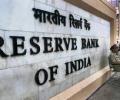
Inflation, remained in negative territory for the 7th month in May
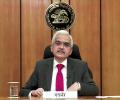
'There are some high-frequency indicators where uptick is visible and some where it is not'

IThe fiscal deficit target for 2020-2021 was originally set at 3.5 per cent of GDP. But the government's revenues have collapsed and its expenditure burden will only increase over the Budget estimates.' With the government having already planned for an additional borrowing of over Rs 4 trillion, the fiscal deficit for the current year would be much higher than the Budget estimate, notes A K Bhattacharya.

'Will Imran compromise with the army? We are all human beings. We all compromise.'

Train passenger fares may soon be linked to inflation rate, sources say, adding that the new model may be based on the Wholesale Price Index.
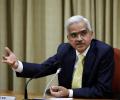
The Reserve Bank of India (RBI) on Friday decided to leave the benchmark interest rate unchanged at 4 per cent but maintained an accommodative stance, implying rate cuts in the future if need arises to support the economy hit by the Covid-19 pandemic.

'Normally, the system is geared towards counting notes -- it is equipped to do x amount of work and one day you are asking them to do 20 x.' 'The processes involved are very complex.'

Home Minister Rajnath Singh said that the decision could cost the government roughly Rs 15,000 crore.

That's why he is now finally focusing on the two things that alone can help: Fiscal expansion -- from December onwards -- and supply management via amended laws and rules that affect business, notes T C A Srinivasa-Raghavan
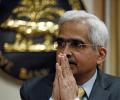
RBI Governor Shaktikanta Das on Friday said the government and the central bank are in discussion with South Asian countries to have cross-border trade in rupee. He also said the central bank digital currency (CBDC) is in trial phase and the RBI is moving very carefully and cautiously on digital rupee launch. After the successful launch of the wholesale pilot, the Reserve Bank of India (RBI) on December 1, last year, began its retail CBDC pilot project.

'To the believers of crypto regulations, I have only one question to ask, how will you regulate it?'
While achieving an eight per cent retail inflation rate by January 2015 is well within reach, Reserve Bank of India Governor Raghuram Rajan notes there is a second target, of six per cent by 2016.
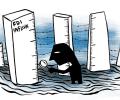
Showing the effect of the slowdown in global economic activity, the equity foreign direct investment (FDI) into India declined sharply to $13.9 billion in April-July 2023 from $22.04 billion a year ago. The net FDI, inflows minus outflows, declined from $17.28 billion in April-July 2022 to $5.70 billion in April-July 2023 on account of moderating gross FDI and a rise in repatriation. Gross FDI into India moderated to $22.0 billion during April-July 2023 from $29.6 billion a year ago, according to Reserve Bank of India data.
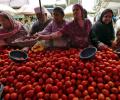
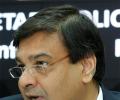
RBI takes steps to control inflation but the masses are not convinced.
The Assocham suggested to the Reserve Bank of India on Monday to take measures to contain inflation and maintain interest rates at the existing level so that the 8 per cent plus GDP growth target is not compromised.

An escalation in the already simmering tensions between North and South Korea, China and Taiwan, and Russia and Ukraine could prove to be a bigger worry for the markets over the next few months rather than central bank policy action, said analysts. The markets, they said, are still not fully factoring in this possibility. "The conflict between Iran and Saudi Arabia is another geopolitical worry.
The Reserve Bank on Wednesday increased the benchmark lending rate by 40 basis points (bps) to 4.40 per cent in a bid to contain inflation, which has remained stubbornly above the target zone of 6 per cent for the last three months. The decision follows an unscheduled meeting of the Monetary Policy Committee (MPC), with all six members unanimously voting for a rate hike while maintaining the accommodative stance. While the inflation has remained above the targetted 6 per cent since January, RBI Governor Shaktikanta Das said the inflation print in April is also likely to be high.

The RBI has targeted consumer price inflation at 6 per cent by January and 4 per cent by March 2018.
Inflation for the first time in 5 years dropped below 3 per cent to 2.97 per cent for the week ended October 27, against 3.02 per cent in the previous week mainly due to fall in prices of food articles and some manufactured items. During the week under review, prices of fruits and vegetables, cereals and pulses declined, while wheat, poultry chicken, fish-marine, milk and eggs went expensive.

'The BJP is using administrative machinery to fight elections'

High inflation print is the price that the Reserve Bank of India (RBI) will have to pay to nurse a fragile growth back, say economists. Wholesale Price Index-based inflation rose to a record high of 12.94 per cent in May, aided by low base effect, but also because of higher fuel and commodity prices. Retail inflation, too, surprised by rising to 6.30 per cent, while the core inflation, which is the non-food and non-fuel component, rose to an 83-month high of 6.55 per cent. These numbers are much above RBI's upper limit of 6 per cent inflation target, but there is very little that the RBI can do at this moment.

Union Finance Minister Nirmala Sitharaman will present the Interim Budget on February 1 ahead of the Lok Sabha elections likely to be held in April-May.

Pakistan-India bilateral relations remained frozen for the fourth year over the vexed Kashmir issue but analysts hope the strained ties could be repaired if Nawaz Sharif becomes the prime minister for a record fourth time in the general elections in February in the absence of his main challenger Imran Khan who is in jail in multiple cases.

'It is not his doing, but Rahul Gandhi is forced by circumstances.' 'In taking political decisions, everything has to get his clearance.'
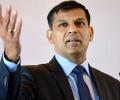
'Too many things happen in India... that is the root of the problem, not Raghuram Rajan'

'Gold prices thrive on volatility and more so when the stock markets trend downward.'
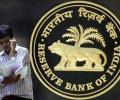
Higher for longer' may be the narrative in the developed markets, but interest rates might not stay high for very long in India, with a section of the market expecting rate cuts to begin this year. The six-member Monetary Policy Committee of Reserve Bank of India (RBI) decided to keep interest rates unchanged at 6.5 per cent in the April review - after hiking the policy repo rate in six previous meetings. RBI Governor Shaktikanta Das emphasised that the pause was only for the April policy and that the central bank was ready to act if the situation demanded.

Decisions should not be based on feelings, such as optimism or pessimism about the stock market or specific investment products, suggests Avinash Luthria.

The Central bank primarily factors Consumer Price Index while deciding on policy rate.
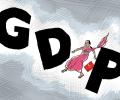
S&P Global Ratings on Monday kept its forecast for India's economic growth unchanged at 6 per cent in the fiscal year starting April 1, before rising to 6.9 per cent in the following year. In the quarterly economic update for Asia-Pacific, S&P saw inflation rate easing to 5 per cent in 2023-24 fiscal, from 6.8 per cent in the current financial year. It saw India's gross domestic product (GDP) likely growing by 7 per cent in the current financial year ending March 31 (2022-23), before slowing to 6 per cent in the next 2023-24 fiscal.
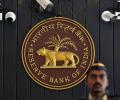
The Reserve Bank of India (RBI) is precariously balancing two opposing objectives - maintaining easy financial condition in the domestic market, while ensuring external stability - and economists have started taking note. They say India is going through the classic trilemma of the 'Impossible Trinity'. The RBI cannot have an independent monetary policy (setting domestic interest rates) in an environment of an open capital account and flexible exchange rates. What is even more complicated for the central bank now is that financial market stability overlays all the other three objectives.

Rise in vegetable prices can reverse the benefits of low oil prices.

The cost of food has constantly been on the rise.

The Enforcement Directorate on Wednesday alleged that bribe money generated from corruption in a Delhi Jal Board (DJB) contract was 'passed on' as election funds to the Aam Aadmi Party that rules the national capital.
